Ford Series 10/30 Tractors (2600-8210) OEM Service & Repair Manual
What's Included?
Lifetime Access
Fast Download Speeds
Online & Offline Access
Access PDF Contents & Bookmarks
Full Search Facility
Print one or all pages of your manual
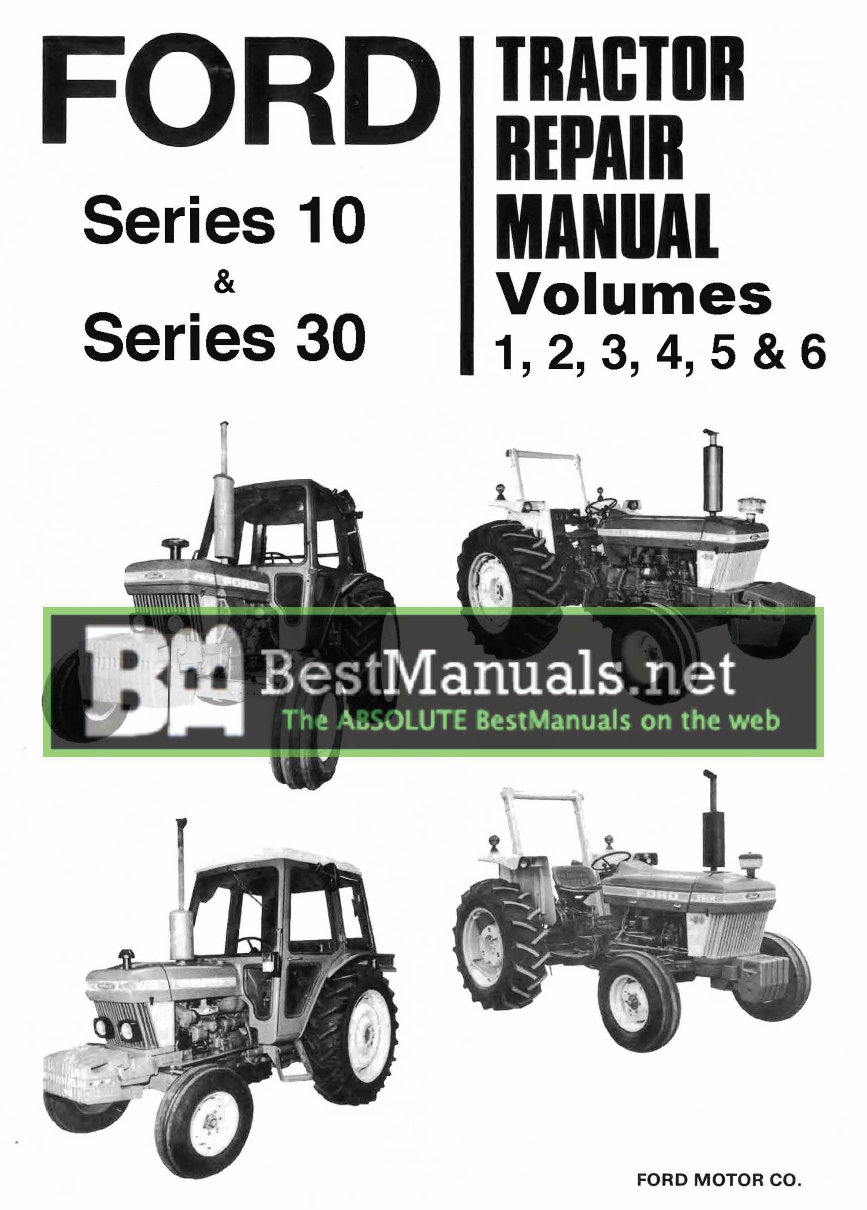
TRACTOR RIPAIR Series 1 0 MANUAL & Volumes Series 30 1,2,3,4,5 & 6 FORD MOTOR CO.
Tractors Series 10 Series 30 Part 1 - Engine Systems Part 2- Fuel Systems Vol. 1 40001020-1 11/95 (J) m JJ < o m s: c ) r I Reprinted I
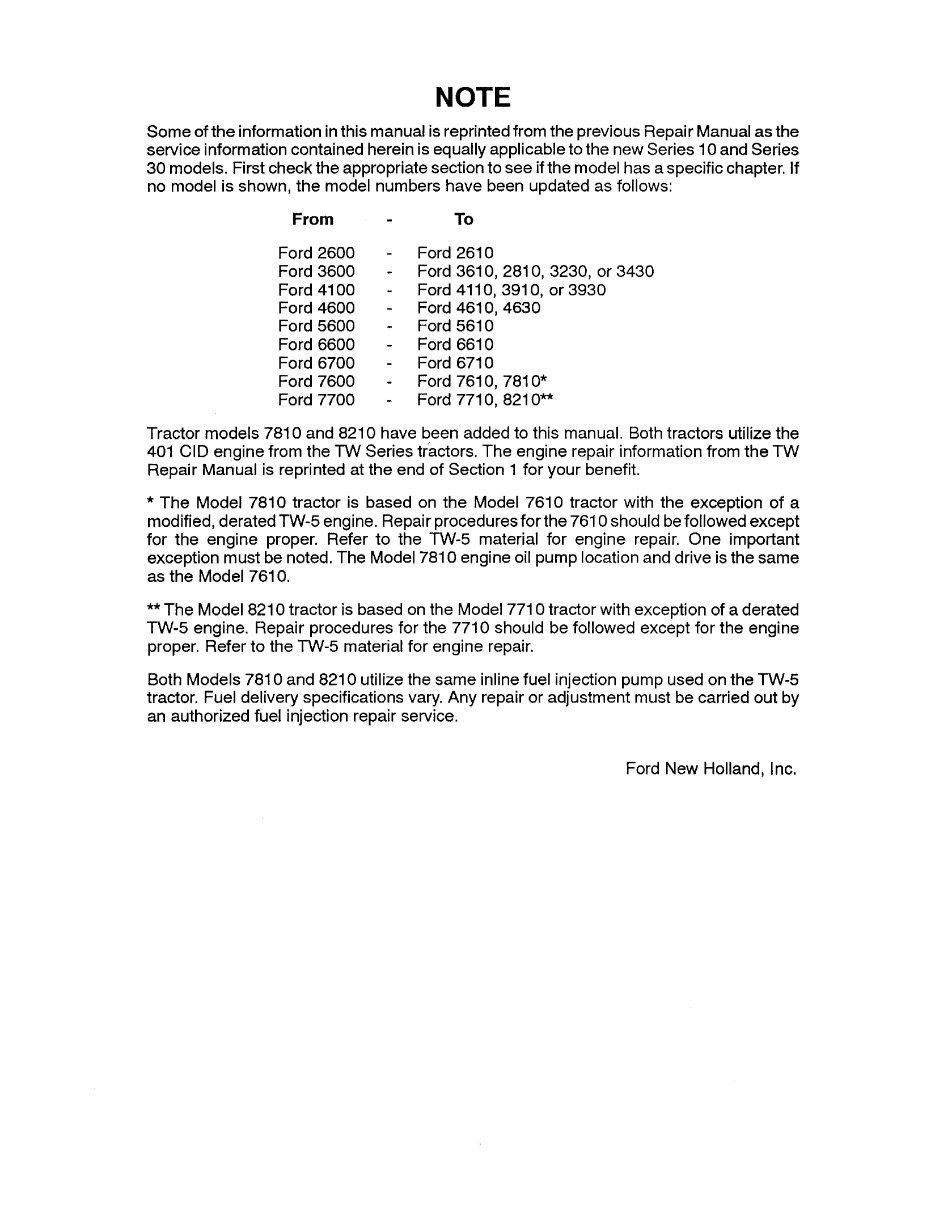
NOTE Some of the information in this manual is reprinted from the previous Repair Manual as the service information contained herein is equally applicable to the new Series 10 and Series 30 models. First check the appropriate section to see if the model has a specific chapter. If no model is shown, the model numbers have been updated as follows: From Ford 2600 Ford 3600 Ford 4100 Ford 4600 Ford 5600 Ford 6600 Ford 6700 Ford 7600 Ford 7700 To Ford 2610 Ford 3610, 2810, 3230, or 3430 Ford 4110, 3910, or 3930 Ford 4610, 4630 Ford 5610 Ford 6610 Ford 6710 Ford 7610, 7810* Ford 7710, 8210** Tractor models 7810 and 8210 have been added to this manual. Both tractors utilize the 401 CID engine from the TW Series tractors. The engine repair information from the TW Repair Manual is reprinted at the end of Section 1 for your benefit. * The Model 7810 tractor is based on the Model 7610 tractor with the exception of a modified, derated TW-5 engine. Repair procedures for the 761 a should be followed except for the engine proper. Refer to the TW-5 material for engine repair. One important exception must be noted. The Model 7810 engine oil pump location and drive is the same as the Model 7610. ** The Model 8210 tractor is based on the Model 7710 tractor with exception of a derated TW-5 engine. Repair procedures for the 7710 should be followed except for the engine proper. Refer to the TW-5 material for engine repair. Both Models 7810 and 8210 utilize the same inline fuel injection pump used on the TW-5 tractor. Fuel delivery specifications vary. Any repair or adjustment must be carried out by an authorized fuel injection repair service. Ford New Holland, Inc.
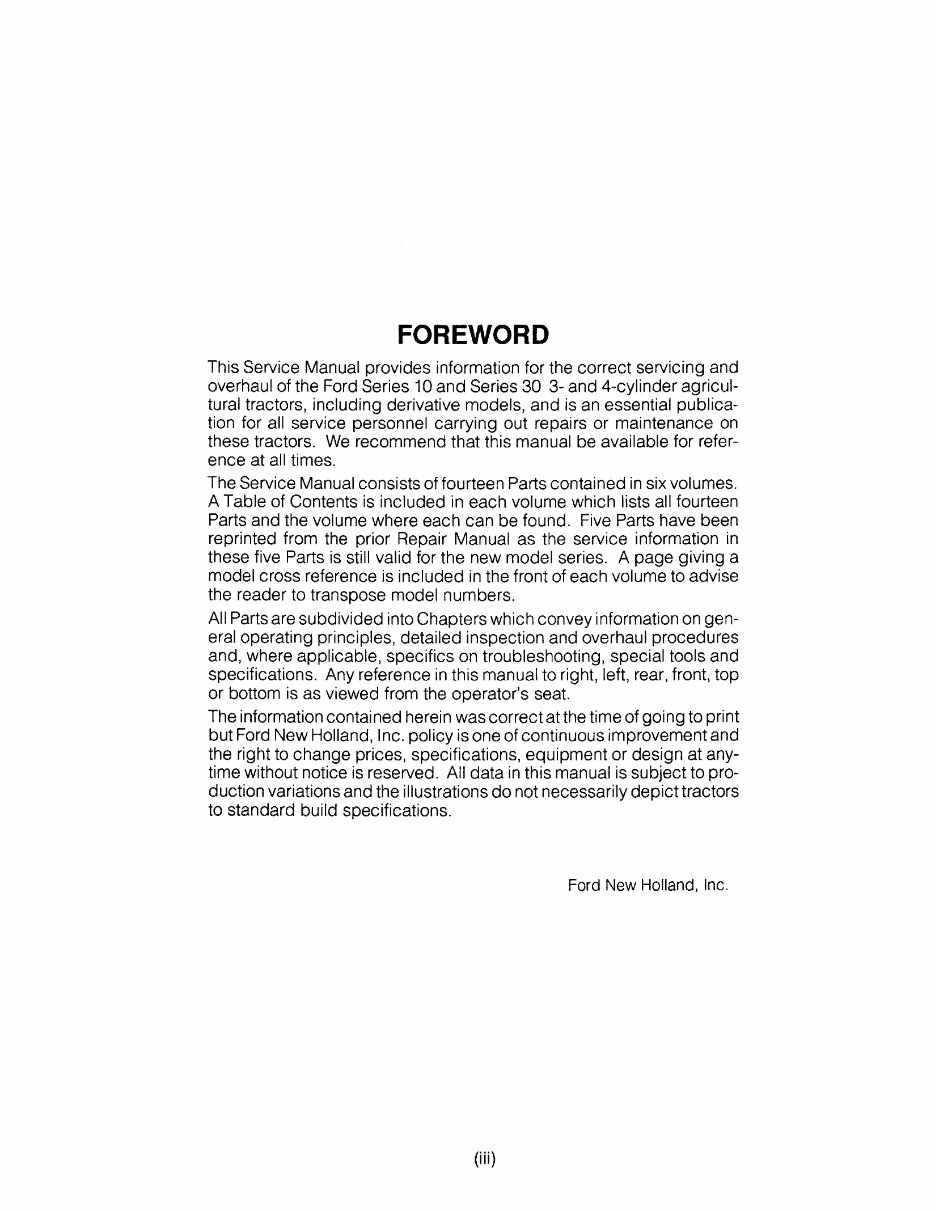
FOREWORD This Service Manual provides information for the correct servicing and overhaul of the Ford Series 10 and Series 30 3- and 4-cylinder agricul- tural tractors, including derivative models, and is an essential publica- tion for all service personnel carrying out repairs or maintenance on these tractors. We recommend that this manual be available for refer- ence at all times. The Service Manual consists of fourteen Parts contained in six volumes. A Table of Contents is included in each volume which lists all fourteen Parts and the volume where each can be found. Five Parts have been reprinted from the prior Repair Manual as the service information in these five Parts is still valid for the new model series. A page giving a model cross reference is included in the front of each volume to advise the reader to transpose model numbers. All Parts are subdivided into Chapters which convey information on gen- eral operating principles, detailed inspection and overhaul procedures and, where applicable, specifics on troubleshooting, special tools and specifications. Any reference in this manual to right, left, rear, front, top or bottom is as viewed from the operator's seat. The information contained herein was correct at the time of going to print but Ford New Holland, Inc. policy is one of continuous improvement and the right to change prices, specifications, equipment or design at any- time without notice is reserved. All data in this manual is subject to pro- duction variations and the illustrations do not necessarily depict tractors to standard build specifications. Ford New Holland, Inc. (i ii)
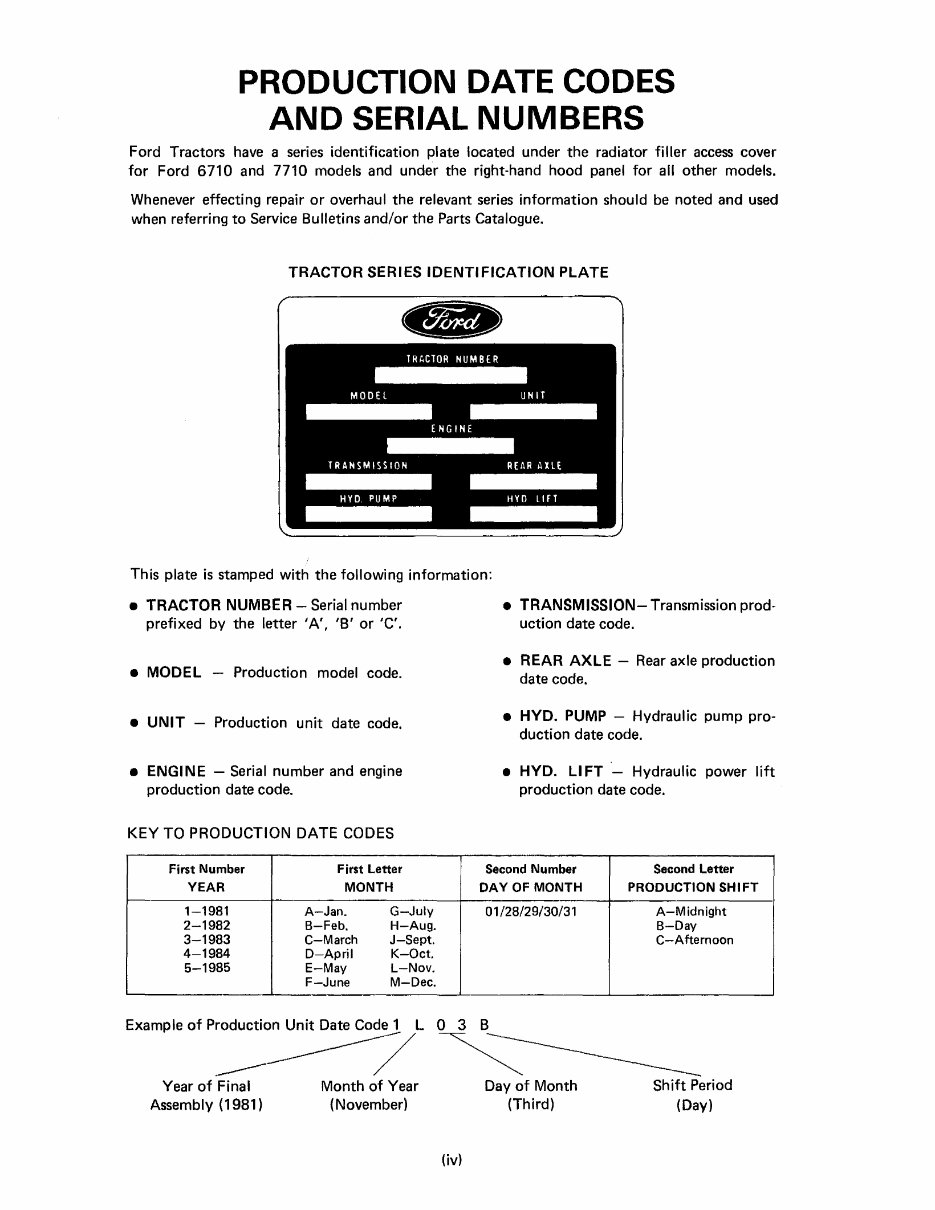
PRODUCTION DATE CODES AND SERIAL NUMBERS Ford Tractors have a series identification plate located under the radiator filler access cover for Ford 6710 and 7710 models and under the right-hand hood panel for all other models. Whenever effecting repair or overhaul the relevant series information should be noted and used when referring to Service Bulletins and/or the Parts Catalogue. TRACTOR SERIES IDENTIFICATION PLATE This plate is stamped with the following information: • TRACTOR NUMBER - Serial number prefixed by the letter 'A', 'B' or 'c', • MODEL - Production model code. • UNIT - Production unit date code. • ENGINE - Serial number and engine production date code. KEY TO PRODUCTION DATE CODES First Number First Letter YEAR MONTH 1-1981 A-Jan. G-July 2-1982 B-Feb. H-Aug. 3-1983 C-March J-Sept. 4-1984 D-April K-Oct. 5-1985 E-May L-Nov. F-June M-Dec. Example of Production Unit Date Code 1 L ~ Year of Final Month of Year Assembly (1981) (November) • TRANSMISSION- Transmission prod- uction date code. • REAR AXLE - Rear axle production date code. • HYD. PUMP - Hydraulic pump pro- duction date code. • HYD. LI FT '- Hydraulic power lift production date code. Second Number Second Letter DAY OF MONTH PRODUCTION SHIFT 01/28/29/30/31 A-Midnight B-Day C-Afternoon o 3 B ~ (iv) Day of Month (Third) Shift Period (Day)
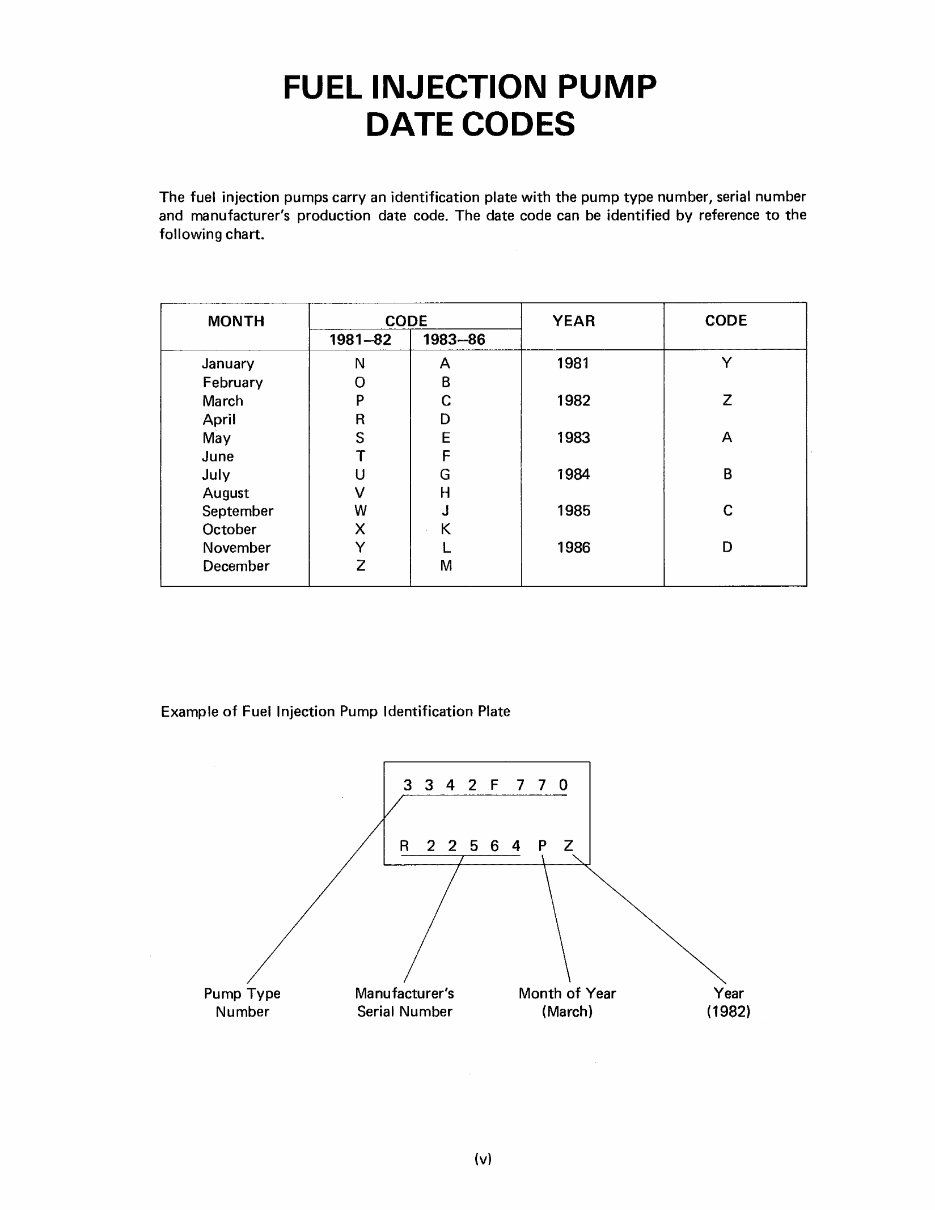
FUEL INJECTION PUMP DATE CODES The fuel injection pumps carry an identification plate with the pump type number, serial number and ma nufacturer's production date code. The date code can be identified by reference to the following chart. MONTH CODE YEAR 1981-82 1983-86 January N A 1981 February a B March P C 1982 April R D May S E 1983 June T F July U G 1984 August V H September W J 1985 October X K November Y L 1986 December Z M Example of Fuel Injection Pump Identification Plate Pump Type Number 3342F 770 R 22564 P Z Manufacturer'S Serial Number (v) Month of Year (March) CODE Y Z A B C D Year (1982)
SAFETY PRECAUTIONS Practically all Service work involves the need to drive the tractor. The Operators Manual, supplied with each tractor, contains detailed safety precautions relating to Driving, Operating and Servicing that tractor. These precautions are as applicable to the service technician as they are to the operator, and should be read, understood and practised by all personnel. Prior to undertaking any maintenance, repair, overhaul, dismantling or re-assembly operations, whether within a workshop facility or out "in the field", consideration should be given to factors that may have an effect upon Safety. Not only upon the mechanic carrying out the work, but also upon bystanders. PERSONAL CONSIDERATIONS • The wrong clothes or carelessness in dress can cause accidents. Check to see that you are suitably clothed. Some jobs require special protective equipment. • Eye Protection The smallest eye injury may cause loss of vision. Injury can be avoided by wearing eye protection when engaged in chiselling, grinding, discing, welding, painting, etc. • Breathing Protection Fumes, dust and paint spray are unpleasant and harmful. These can be avoided by wearing respiratory protection. • Hearing Protection Loud noise may damage your hearing and the greater the exposure the worse the damage. If you feel the noise excessive wear ear protection. • Hand Protection It is advisable to use a protective cream before work to prevent irritation and skin contamination. After work clean your hands with soap and water. Solvents such as white spirit, paraffin, etc., may harm the skin. • Foot Protection Substantial or protective footwear with reinforced toe-caps will protect your feet from falling objects. Additionally oil-resistant soles will help to avoid slipping. • Special Clothing For certain work it may be necessary to wear flame- or acid- resistant clothing. • Avoid injury through incorrect handling of components. Make sure you are capable of lifting the object. If in doubt get help. EQUIPMENT CONSIDERATIONS • Machine Guards Before using any machine, check to ensure that the machine guards are in position and serviceable. These guards not only prevent parts of the body or clothing coming in contact with the moving parts of the machine, but also ward off objects that might fly off the machine and cause injury. • Lifting Appliances Always ensure that lifting equipment, such as chains, slings, lifting brackets, hooks and eyes are thoroughly checked before use. If in doubt, select stronger equipment than is necessary. Never stand under a suspended load or raised implement. • Compressed Air The pressure from a compressed air line is often as high as 100 Ibf lin 2 (6.9 bar) (7 kgf/cm2). It is perfectly safe if used correctly. Any misuse may cause injury. Never use compressed air to blow dust, swarf, dirt, etc., away from your work area unless the correct type of nozzle is fitted. Compressed air is not a cleaning agent, it will only move dust, etc., from one place to another. Look around before using an air hose as bystanders, may get grit into their eyes, ears or skin. (vi)
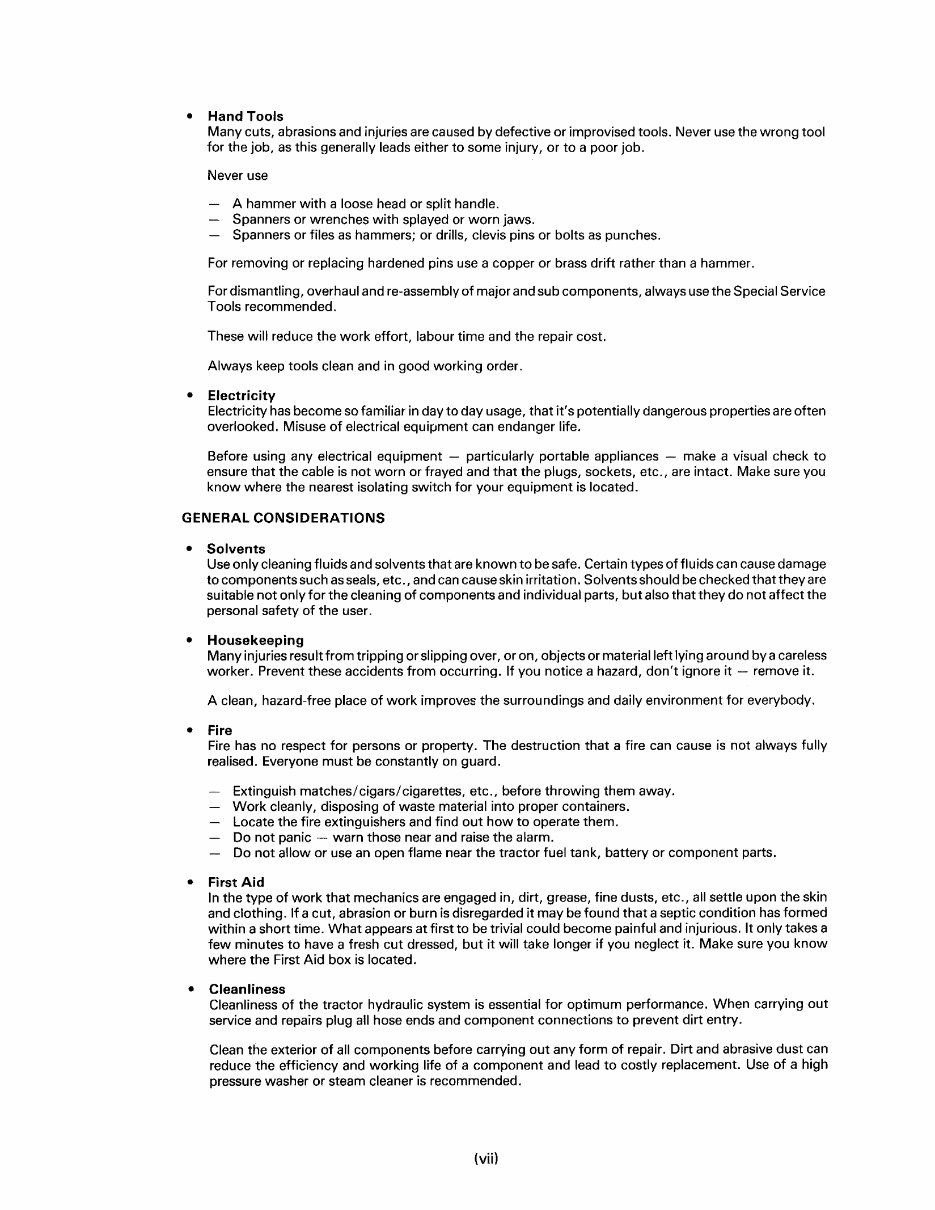
• Hand Tools Many cuts, abrasions and injuries are caused by defective or improvised tools. Never use the wrong tool for the job, as this generally leads either to some injury, or to a poor job. Never use A hammer with a loose head or split handle. - Spanners or wrenches with splayed or worn jaws. - Spanners or files as hammers; or drills, clevis pins or bolts as punches. For removing or replacing hardened pins use a copper or brass drift rather than a hammer. For dismantling, overhaul and re-assembly of major and sub components, always use the Special Service Tools recommended. These will reduce the work effort, labour time and the repair cost. Always keep tools clean and in good working order. • Electricity Electricity has become so familiar in day to day usage, that it's potentially dangerous properties are often overlooked. Misuse of electrical equipment can endanger life. Before using any electrical equipment - particularly portable appliances - make a visual check to ensure that the cable is not worn or frayed and that the plugs, sockets, etc., are intact. Make sure you know where the nearest isolating switch for your equipment is located. GENERAL CONSIDERATIONS • Solvents Use only cleaning fluids and solvents that are known to be safe. Certain types offluids can cause damage to components such as seals, etc., and can cause skin irritation. Solvents should be checked that they are suitable not only for the cleaning of components and individual parts, but also that they do not affect the personal safety of the user. • Housekeeping Many injuries result from tripping or slipping over, or on, objects or material left lying around by a careless worker. Prevent these accidents from occurring. If you notice a hazard, don't ignore it remove it. A clean, hazard-free place of work improves the surroundings and daily environment for everybody. • Fire Fire has no respect for persons or property. The destruction that a fire can cause is not always fully realised. Everyone must be constantly on guard. Extinguish matches/cigars/cigarettes, etc., before throwing them away. Work cleanly, disposing of waste material into proper containers. Locate the fire extinguishers and find out how to operate them. Do not panic warn those near and raise the alarm. Do not allow or use an open flame near the tractor fuel tank, battery or component parts. • First Aid In the type of work that mechanics are engaged in, dirt, grease, fine dusts, etc., all settle upon the skin and clothing. If a cut, abrasion or burn is disregarded it may be found that a septic condition has formed within a short time. What appears at first to be trivial could become painful and injurious. It only takes a few minutes to have a fresh cut dressed, but it will take longer if you neglect it. Make sure you know where the First Aid box is located. • Cleanliness Cleanliness of the tractor hydraulic system is essential for optimum performance. When carrying out service and repairs plug all hose ends and component connections to prevent dirt entry. Clean the exterior of all components before carrying out any form of repair. Dirt and abrasive dust can reduce the efficiency and working life of a component and lead to costly replacement. Use of a high pressure washer or steam cleaner is recommended. (vii)
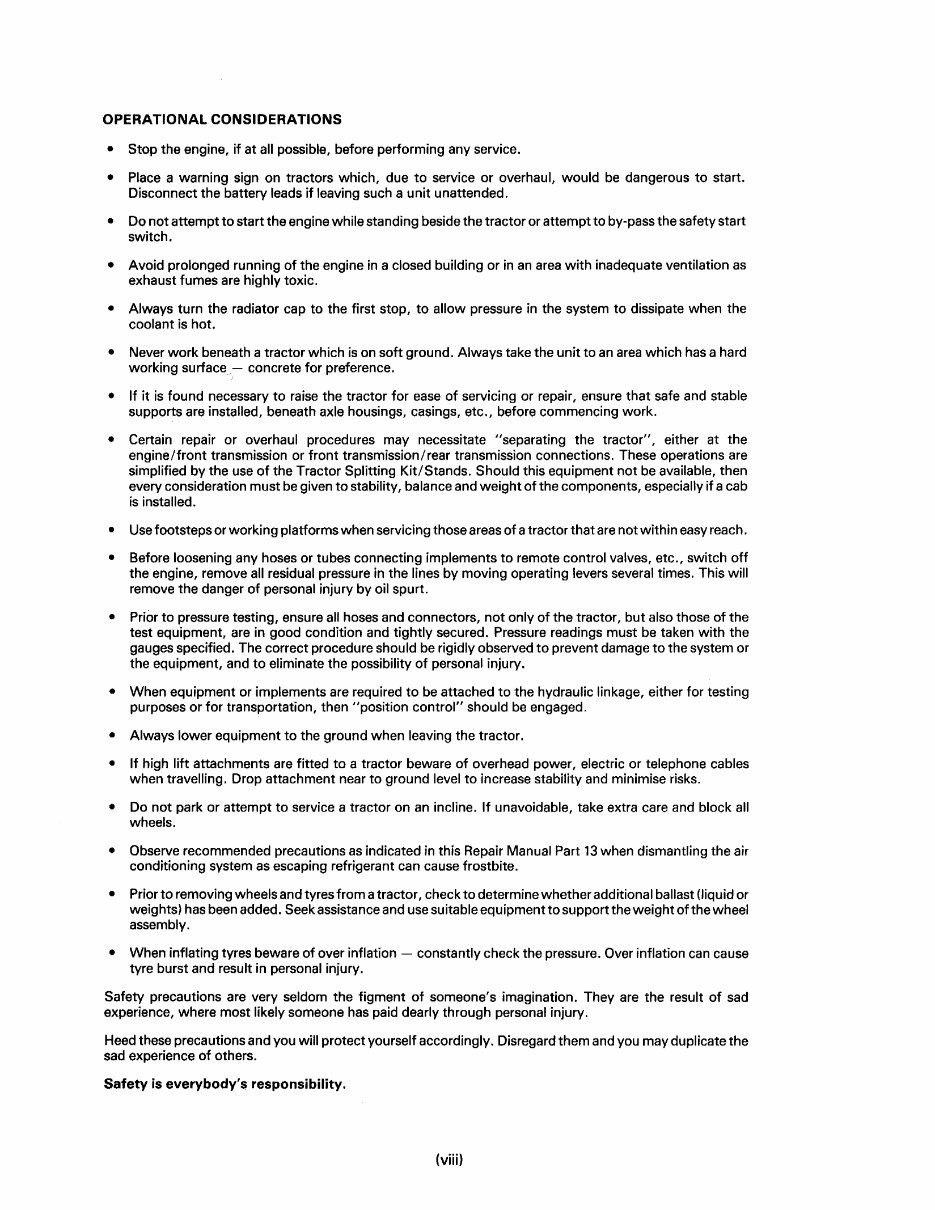
OPERATIONAL CONSIDERATIONS • Stop the engine, if at all possible, before performing any service. • Place a warning sign on tractors which, due to service or overhaul, would be dangerous to start. Disconnect the battery leads if leaving such a unit unattended. • Do not attempt to start the engine while standing beside the tractor or attempt to by-pass the safety start switch. • Avoid prolonged running of the engine in a closed building or in an area with inadequate ventilation as exhaust fumes are highly toxic. • Always turn the radiator cap to the first stop, to allow pressure in the system to dissipate when the coolant is hot. • Never work beneath a tractor which is on soft ground. Always take the unit to an area which has a hard working surface ',- concrete for preference. • If it is found necessary to raise the tractor for ease of servicing or repair, ensure that safe and stable supports are installed, beneath axle housings, casings, etc., before commencing work. • Certain repair or overhaul procedures may necessitate "separating the tractor", either at the engine/front transmission or front transmission/rear transmission connections. These operations are simplified by the use of the Tractor Splitting Kit/Stands. Should this equipment not be available, then every consideration must be given to stability, balance and weight of the components, especially if a cab is installed. • Use footsteps or working platforms when servicing those areas of a tractor that are not within easy reach. • Before loosening any hoses or tubes connecting implements to remote control valves, etc., switch off the engine, remove all residual pressure in the lines by moving operating levers several times. This will remove the danger of personal injury by oil spurt. • Prior to pressure testing, ensure all hoses and connectors, not only of the tractor, but also those of the test equipment, are in good condition and tightly secured. Pressure readings must be taken with the gauges specified. The correct procedure should be rigidly observed to prevent damage to the system or the equipment, and to eliminate the possibility of personal injury. • When equipment or implements are required to be attached to the hydraulic linkage, either for testing purposes or for transportation, then "position control" should be engaged. • Always lower equipment to the ground when leaving the tractor. • If high lift attachments are fitted to a tractor beware of overhead power, electric or telephone cables when travelling. Drop attachment near to ground level to increase stability and minimise risks. • Do not park or attempt to service a tractor on an incline. If unavoidable, take extra care and block all wheels. • Observe recommended precautions as indicated in this Repair Manual Part 13 when dismantling the air conditioning system as escaping refrigerant can cause frostbite. • Prior to removing wheels and tyres from a tractor, check to determine whether additional ballast (liquid or weights) has been added. Seek assistance and use suitable equipmentto supportthe weight of the wheel assembly. • When inflating tyres beware of over inflation - constantly check the pressure. Over inflation can cause tyre burst and result in personal injury. Safety precautions are very seldom the figment of someone's imagination. They are the result of sad experience, where most likely someone has paid dearly through personal injury. Heed these precautions and you will protect yourself accordingly. Disregard them and you may duplicate the sad experience of others. Safety is everybody's responsibility. (viii)
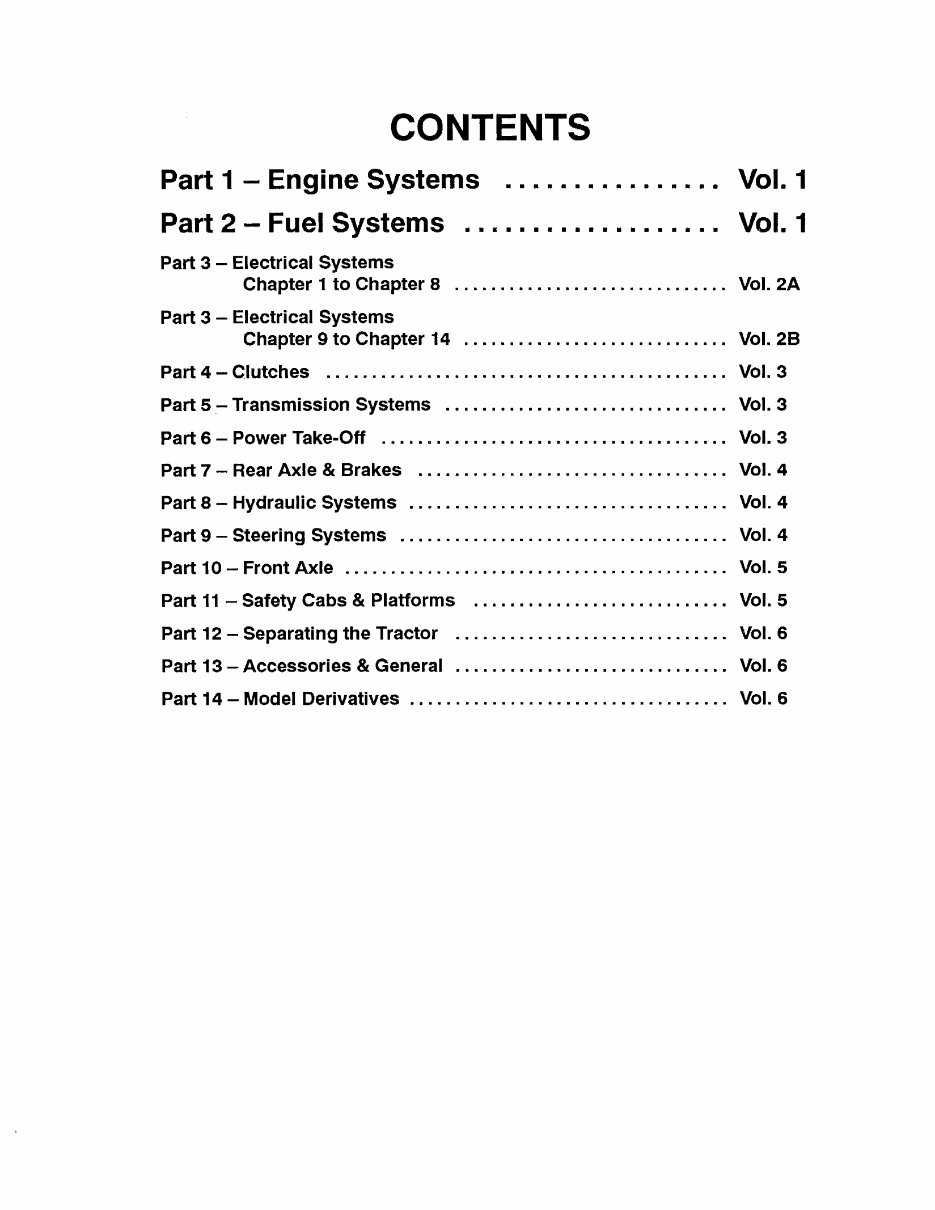
CONTENTS Part 1 - Engine Systems II II II II II II II II II • II •• II •• Vol. 1 Part 2 - Fuel Systems .. II •••••••••• II II II II • II Vol. 1 Part 3 - Electrical Systems Chapter 1 to Chapter 8 .............................. Vol. 2A Part 3 - Electrical Systems Chapter 9 to Chapter 14 ............................. Vol. 2B Part 4 - Clutches ............................................ Vol. 3 Part 5 - Transmission Systems ............................... Vol. 3 Part 6 - Power Take-Off ...................................... Vol. 3 Part 7 - Rear Axle & Brakes .................................. Vol. 4 Part 8 - Hydraulic Systems ................................... Vol. 4 Part 9 - Steering Systems .................................... Vol. 4 Part 10 - Front Axle .......................................... Vol. 5 Part 11 - Safety Cabs & Platforms ............................ Vol. 5 Part 12 - Separating the Tractor .............................. Vol. 6 Part 13 - Accessories & General .............................. Vol. 6 Part 14 - Model Derivatives ................................... Vol. 6
Ford Series 10/30 Tractors (2600 to 8210) Service & Repair Manual
Models covered:
Ford 2600
Ford 2610
Ford 2810
Ford 3230
Ford 3430
Ford 3600
Ford 3610
Ford 3910
Ford 3930
Ford 4100
Ford 4110
Ford 4600
Ford 4610
Ford 4630
Ford 5600
Ford 5610
Ford 6600
Ford 6610
Ford 6700
Ford 6710
Ford 7600
Ford 7610
Ford 7700
Ford 7710
Ford 7810
Ford 8210
The Ford Series 10/30 Tractors (2600-8210) Service & Repair Manual is a comprehensive technical guide for maintaining and repairing these tractor models. It provides accurate diagrams and step-by-step instructions covering all major systems, including the engine, transmission, hydraulics, and electrical.
This manual includes clear guidance for routine maintenance tasks like oil changes, filter replacements, and hydraulic fluid checks. It also offers detailed troubleshooting and repair instructions for complex systems such as engine diagnostics, transmission servicing, and electrical troubleshooting. Accurate torque specifications, wiring diagrams, and hydraulic flow charts make it easier to identify and resolve technical issues.
Useful for both professional technicians and DIY enthusiasts, this manual provides essential technical data needed to perform regular maintenance and tackle major repairs, ensuring that Ford Series 10/30 tractors remain reliable and efficient in the field, maximizing productivity and longevity.
Format: PDF Language: English Compatibility: Compatible with various electronic devices including PC, Mac, Android, and Apple devices. Requirements: Adobe Reader (free)
Recently Viewed
5,521,897Happy Clients
2,594,462eManuals
1,120,453Trusted Sellers
15Years in Business
Price:
Actual Price:
Ford Series 10/30 Tractors (2600-8210) OEM Service & Repair Manual




 Lifetime Access