

sales@mi com
www.midwestmanuals.com
This quick reference guide will assist
you in locating a desired topic or pro-
cedure.
-Send the pages back to match the
black tab of the desired chapter num-
ber with the black tab on the edge at
each table of contents page.
-Refer to the sectional table of contents
for the exact pages to locate the spe-
cific topic required.
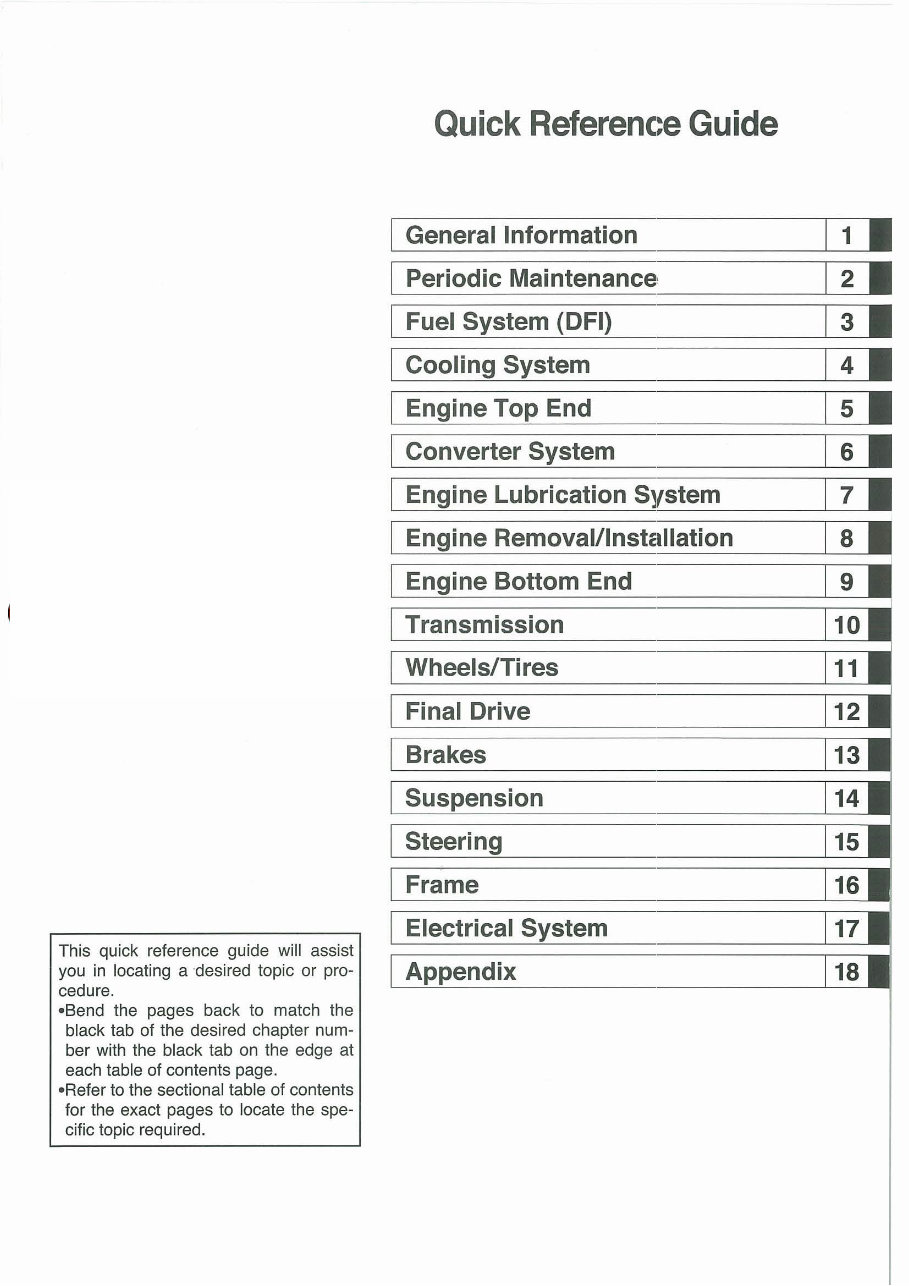
Quick Reference Guide
General Information
Periodic Maintenance,
Fuel System (DFI)
Cooling System
Engine Top End
Converter System
Engine Lubrication System
ne Removal/Installation
ne Bottom End
Transmission
Wheels/Tires
Final Drive
on
Frame
Electrical
dix
1
•
2
•
3
•
4
•
5
•
6
•
7
•
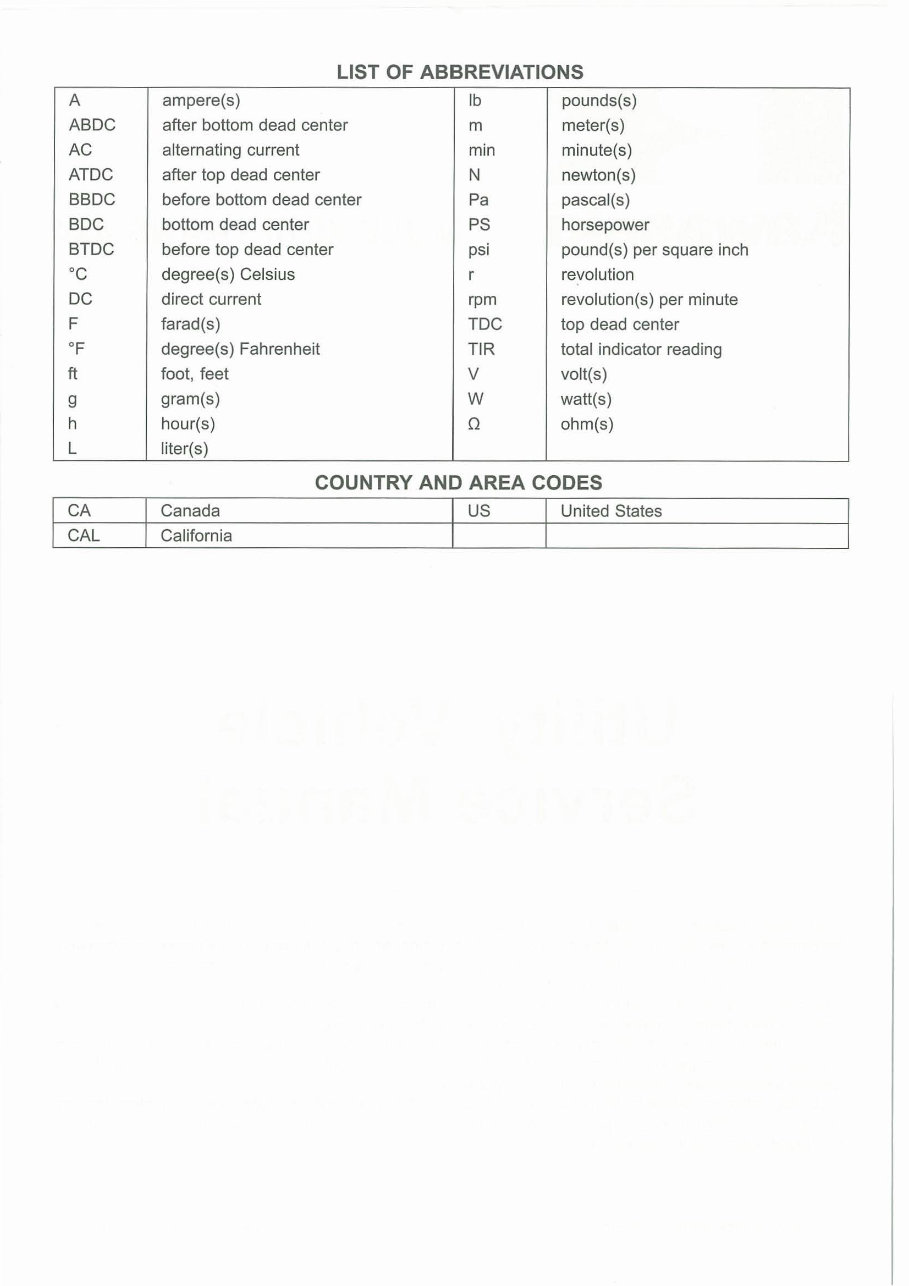
LIST OF ABBREVIATIONS
A ampere(s)
Ib pounds(s)
ABDC
after bottom dead center m meter(s)
AC alternating current min minute(s)
ATOC after top dead center
N
newton(s)
BBDC before bottom dead center
Pa pascal(s)
BDC bottom dead center
PS horsepower
BTOC
before top dead center psi pound(s) per square inch
°C degree(s) Celsius r revolution
DC direct current rpm
revolution(s) per minute
F farad(s)
TOC top dead center
of
degree(s) Fahrenheit TIR total indicator reading
ft foot, feet V volt(s)
9
gram(s)
W watt(s)
h
hour(s)
Q
ohm(s)
L liter(s)
COUNTRY AND AREA CODES
CA Canada
US United States
CAL California

WE RECOMMEND THAT ALL DEALERS OBSERVE THESE PROVISIONS OF FEDERAL
LAW, THE VIOLATION OF WHICH IS PUNISHABLE BY CIVIL PENALTIES NOT EXCEEDING
$10000 PER VIOLATION.
PLEASE DO NOT TAMPER WITH NOISE CONTROL SYSTEM
(US Model only)
To minimize the noise emissions from this product, Kawasaki has equipped it with effective
inlet and exhaust silencing systems. They are designed to give optimum performance while
maintaining a low noise level. Please do not remove these systems, or alter them in any way
which results in an increase in noise level.
Foreword
This manual is designed primarily for use by
trained mechanics in a properly equipped shop.
However, it contains enough detail and basic in-
formation to make it useful to the owner who de-
sires to perform his own basic maintenance and
repair work. A basic knowledge of mechanics,
the proper use of tools, and workshop proce-
dures must be understood in order to carry out
maintenance and repair satisfactorily. When-
ever the owner has insufficient experience or
doubts his ability to do the work, all adjust-
ments, maintenance, and repair should be car-
ried out only by qualified mechanics.
In order to perform the work efficiently and
to avoid costly mistakes, read the text, thor-
oughly familiarize yourself with the procedures
before starting work, and then do the work care-
fully in a clean area. Whenever special tools or
equipment are specified, do not use makeshift
tools or eqUipment. Precision measurements
can only be made if the proper instruments are
used, and the use of substitute tools may ad-
versely affect safe operation.
For the duration of the warranty period,
we recommend that all repairs and scheduled
maintenance be performed in accordance with
this service manual. Any owner maintenance or
repair procedure not performed in accordance
with this manual may void the warranty.
To get the longest life out of your vehicle.
• Follow the Periodic Maintenance Chart in the
Service Manual.
• Be alert for problems and non-scheduled
maintenance.
• Use proper tools and genuine Kawasaki Vehi-
cle parts. Special tools, gauges, and testers
that are necessary when servicing Kawasaki
vehicles are introduced by the Service Man-
ual. Genuine parts provided as spare parts
are listed in the Parts Catalog.
• Follow the procedures in this manual care-
fully. Don't take shortcuts.
• Remember to keep complete records of main-
tenance and repair with dates and any new
parts installed .
How to Use This Manual
In this manual, the product is divided into
its major systems and these systems make up
the manual's chapters. The Quick Reference
Guide shows you all of the product's system
and assists in locating their chapters. Each
chapter in turn has its own comprehensive Ta-
ble of Contents.
For example, if you want engine oil informa-
tion, use the Quick Reference Guide to locate
the Engine Lubrication System chapter. Then,
use the Table of Contents on the first page of
the chapter to find the Engine Oil section.
Whenever you see these WARNING and
CAUTION symbols, heed their instructions!
Always follow safe operating and maintenance
practices.
A WARNING
This warning symbol identifies special
instructions or procedures which, if not
correctly followed, could result in per-
sonal injury, or loss of life.
CAUTION
This caution
symbol identifies special
instructions or procedures which, if not
strictly observed, could result in dam-
age to or destruction of equipment.
This manual contains four more symbols (in
addition to WARNING and CAUTION) which will
help you distinguish different types of informa-
tion.
NOTE
o This note symbol indicates points of par-
ticular interest for more efficient and con-
venient operation.
• Indicates a procedural step or work to be
done.
Olndicates a procedural sub-step or how to do
the work of the procedural step it follows. It
also precedes the text of a NOTE.
* Indicates a conditional step or what action to
take based on the results of the test or inspec-
tion in the procedural step or sub-step it fol-
lows.
In most chapters an exploded view illustration
of the system components follows the Table of
Contents. In these illustrations you will find the
instructions indicating which parts require spec-
ified tightening torque, oil, grease or a locking
agent during assembly.
1-2 GENERAL INFORMATION
Before Servicing
Before starting to perform an inspection service or carry out a disassembly and reassembly oper-
ation on a vehicle, read the precautions given below. To facilitate actual operations, notes, illustra-
tions, photographs, cautions, and detailed descriptions have been included in each chapter wherever
necessary. This section explains the items that require particular attention during the removal and
reinstallation or disassembly and reassembly of general parts.
Especially note the following.
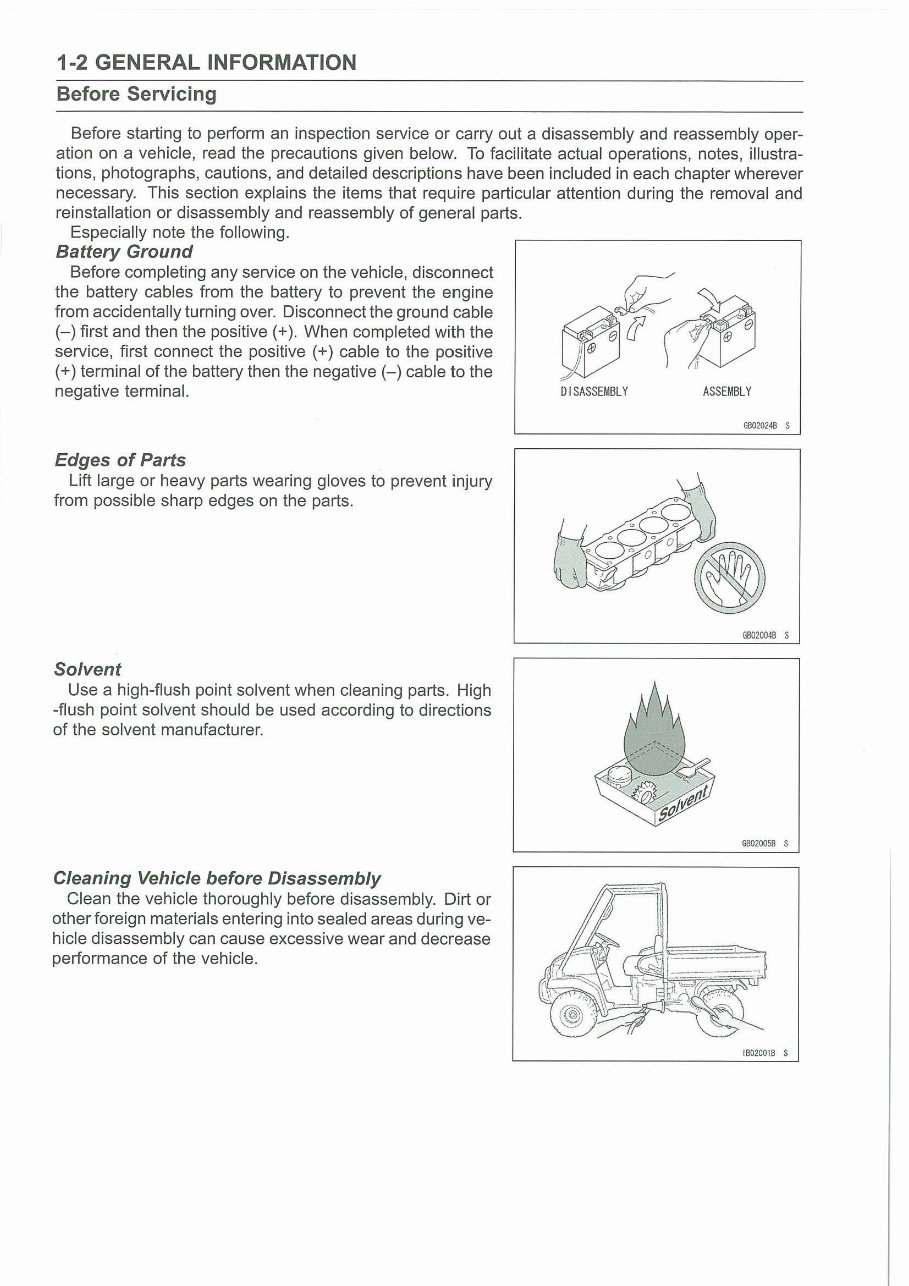
Battery Ground
Before completing any service on the vehicle, disconnect
the battery cables from the battery to prevent the engine
from accidentally turning over. Disconnect the ground cable
(-) first and then the positive (+). When completed with the
service, first connect the positive (+) cable to the positive
(+) terminal of the battery then the negative (-) cable to the
negative terminal.
Edges of Parts
Lift large or heavy parts wearing gloves to prevent injury
from possible sharp edges on the parts.
Solvent
Use a high-flush point solvent when cleaning parts. High
-flush point solvent should be used according to directions
of the solvent manufacturer.
Cleaning Vehicle before Disassembly
Clean the vehicle thoroughly before disassembly. Dirt or
other foreign materials entering into sealed areas during ve-
hicle disassembly can cause excessive wear and decrease
performance of the vehicle.
DISASSEMBLY ASSEMBLY
G8020248 S
GB020048 S
00020058 S
18020018 S
Before Servicing
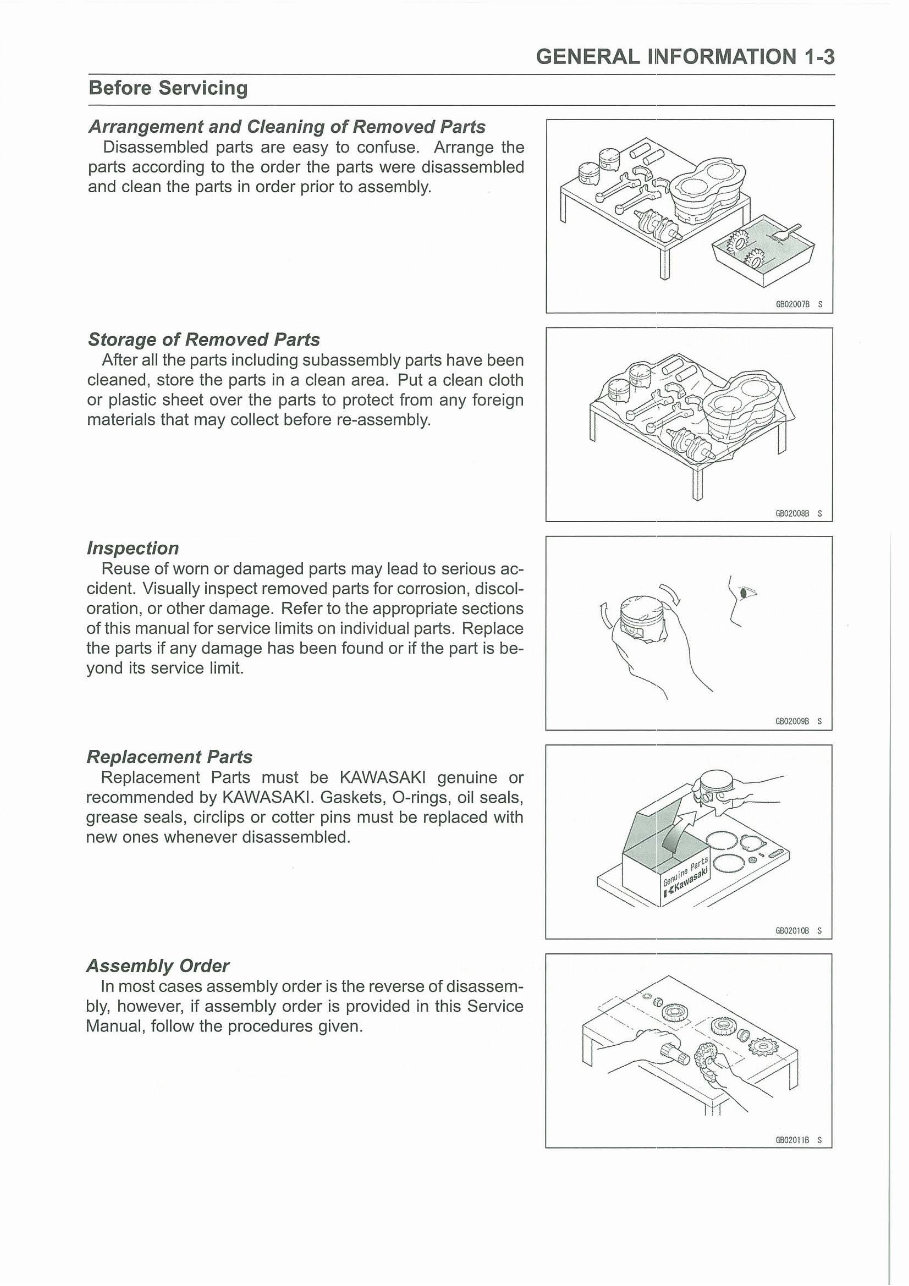
Arrangement and Cleaning of Removed Parts
Disassembled parts are easy to confuse. Arrange the
parts according to the order the parts were disassembled
and clean the parts in order prior to assembly.
Storage of Removed Parts
After all the parts including subassembly parts have been
cleaned, store the parts in a clean area. Put a clean cloth
or plastic sheet over the parts to protect from any foreign
materials that may collect before re-assembly.
Inspection
Reuse of worn or damaged parts may lead to serious ac-
cident. Visually inspect removed parts for corrosion , discol-
oration, or other damage. Refer to the appropriate sections
of this manual for service limits on individual parts. Replace
the parts if any damage has been found or if the part is be-
yond its service limit.
Replacement Parts
Replacement Parts must be KAWASAKI genuine or
recommended by KAWASAKI. Gaskets, O-rings, oil seals,
grease seals, circlips or cotter pins must be replaced with
new ones whenever disassembled.
Assembly Order
In most cases assembly order is the reverse of disassem-
bly, however, if assembly order is provided in this Service
Manual, follow the procedures given.
GENERAL liN FORMATION 1-3
G602007B s
GBOZOOSB S
G80Z009B S
G6020100 S
G0020116 S
1-4 GENERAL INFORMATION
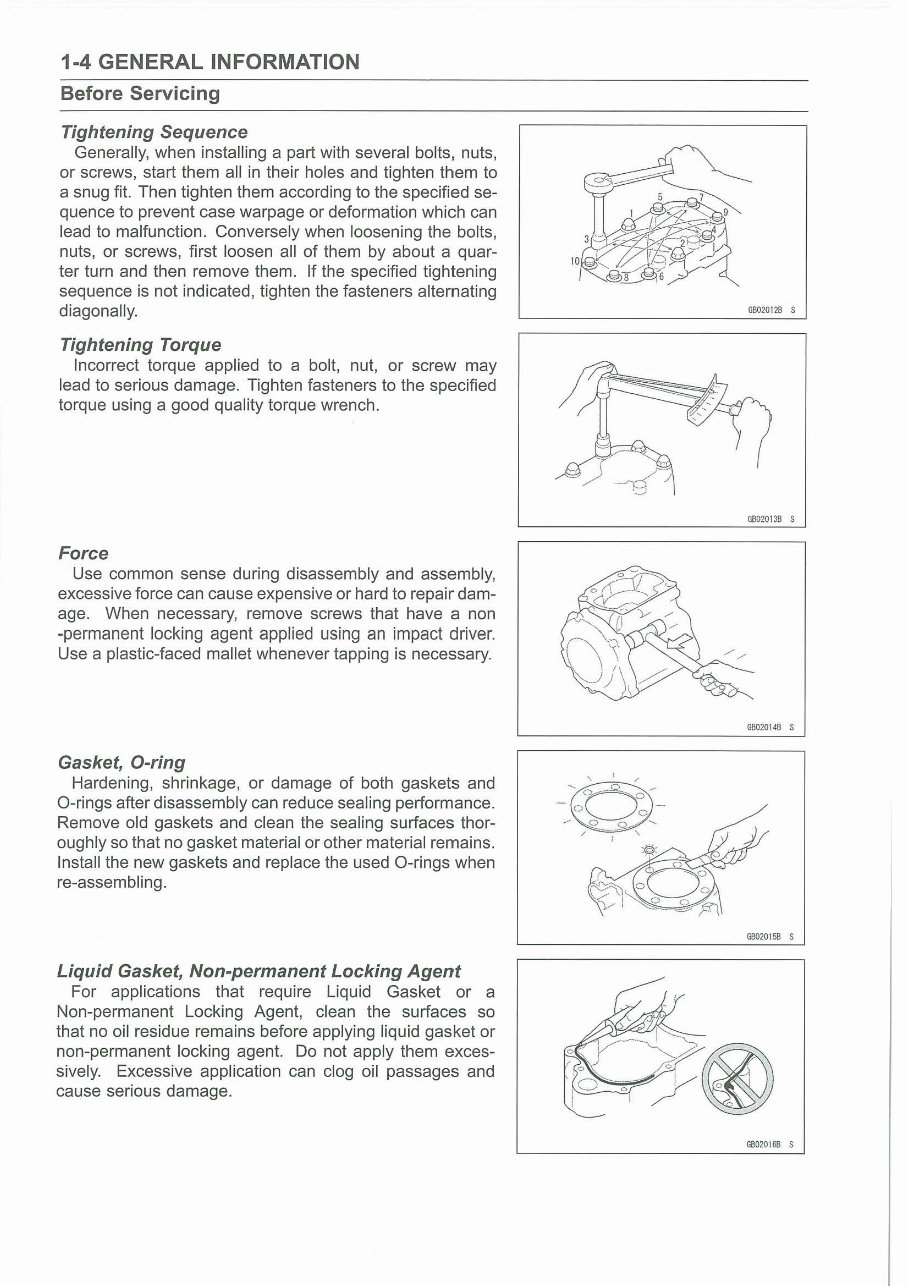
Before Servicing
Tightening Sequence
Generally, when installing a part with several bolts, nuts,
or screws, start them all in their holes and tighten them to
a snug fit. Then tighten them according to the specified se-
quence to prevent case warpage or deformation which can
lead to malfunction. Conversely when loosening the bolts,
nuts, or screws, first loosen all of them by about a quar-
ter turn and then remove them. If the specified tightening
sequence is not indicated, tighten the fasteners alternating
diagonally.
Tightening Torque
Incorrect torque applied to a bolt, nut, or screw may
lead to serious damage. Tighten fasteners to the specified
torque using a good quality torque wrench.
Force
Use common sense during disassembly and assembly,
excessive force can cause expensive or hard to repair dam-
age. When necessary, remove screws that have a non
-permanent locking agent applied using an impact driver.
Use a plastic-faced mallet whenever tapping is necessary.
Gasket, D-ring
Hardening, shrinkage, or damage of both gaskets and
O-rings after disassembly can reduce sealing performance.
Remove old gaskets and clean the sealing surfaces thor-
oughly so that no gasket material or other material remains.
Install the new gaskets and replace the used O-rings when
re-assembling.
Liquid Gasket, Non-permanent Locking Agent
For applications that require Liquid Gasket or a
Non-permanent Locking Agent, clean the surfaces so
that no oil residue remains before applying liquid gasket or
non-permanent locking agent. Do not apply them exces-
sively. Excessive application can clog oil passages and
cause serious damage.
GB020128 s
GB02013B S
GB02014B S
G8020158 S
G602016B S
You're Reading a Preview
What's Included?
 Lifetime Access
Fast Download Speeds
Online & Offline Access
Access PDF Contents & Bookmarks
Full Search Facility
Print one or all pages of your manual
$31.99
2009 Kawasaki Mule 4010 KAF620 UTV Service & Repair Manual
Viewed 54 Times Today

What's Included?
Lifetime Access
Fast Download Speeds
Online & Offline Access
Access PDF Contents & Bookmarks
Full Search Facility
Print one or all pages of your manual
$31.99

Secure transaction
What's Included?
Lifetime Access
Fast Download Speeds
Online & Offline Access
Access PDF Contents & Bookmarks
Full Search Facility
Print one or all pages of your manual
Description
Rebuild your 2009 Kawasaki Mule 4010 KAF620 from the ground up. This service and repair manual walks you through every system, from engine teardown to electrical troubleshooting, with step-by-step procedures, torque specs, and detailed part diagrams across 538 pages. Whether you're replacing a transmission seal or diagnosing a fuel system fault, you'll find what you need fast.
Download instantly and start working. Print it, save it to disc, search it on screen. No restrictions, no waiting. The manual is yours to use however you work best. One payment, instant access, done.


