


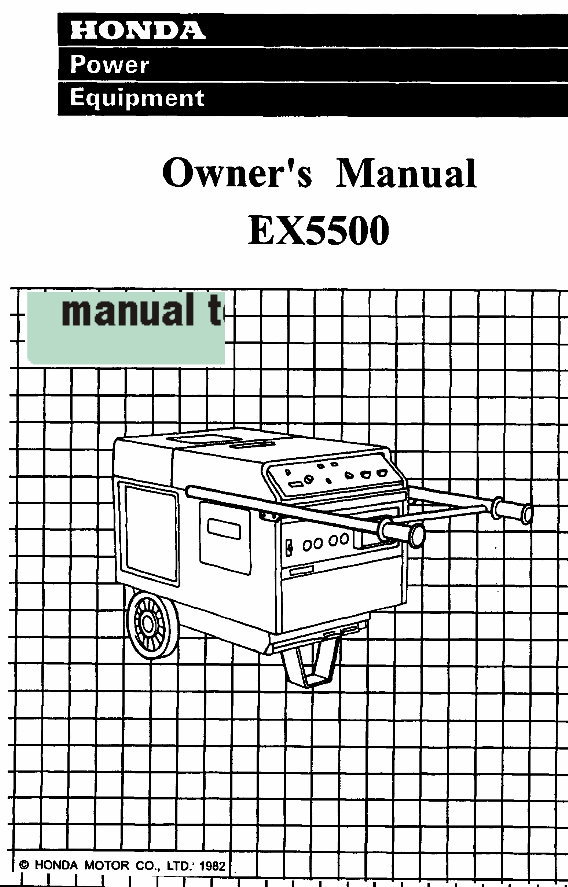
Owner’s Manual
EX5500

Thank you for purchasing a Honda generator.
This manual covers operation and maintenance of the EX5500 generator. All
information in this publication is based on the latest product information
available at the time of approval for printing.
Honda Motor Co., Ltd. reserves the right to make changes at any time without
notice and without incurring any obligation.
.
No part of this publication may be reproduced without written permission.
This manual should be considered a permanent part of the generator and
remain with the generator when sold.
Pay special attention to statements preceded by the following words:
m Indicates a strong possibility of severe personal injury or loss of
life if instructions are not followed.
CAUTION: Indicates a possibility of personal injury or equipment damage if
instructions are not followed.
NOTE: Gives helpful information.
If a problem should arise, or if you have any questions about the generator,
consult an authorized Honda dealer.
B The Honda generator is designed to give safe and dependable
service if operated according to instructions. Read and understand the
Owner’s Manual before operating the generator. Failure to do so could result
in personal injury or equipment damage.
CONTENTS
CONTENTS
1. GENERATOR SAFETY ....................... 1
2. COMPONENT IDENTIFICATION .................. 2
3. PRE-OPERATION CHECK ...................... 4
4. STARTING THE ENGINE ...................... 8
5:GENERATOR USE .......................... 12
6. STOPPING THE ENGINE ....................... 14
7. MAlNTENAi)lCE ........................... 16
8. TRANSPORTING/STORAGE .................... 25
. 9. TROUBLESHOOTING ........................ 27
10. SPECIFICATIONS .......................... 29
11. WIRING DIAGRAM ......................... 30
12. INSTALLATION OF OPTIONAL PARTS ................ 31
I. GENERATOR SAFETY
To ensure safe operation -
l Place the generator at least 1 m (3 ft) away from buildings or other
equipment when operating the generator.
l Operate the generator on a level surface.
If the generator is tilted, fuel spillage may result.
l Exhaust gas contains poisonous carbon monoxide.
Never run the generator in an enclosed area.
Be sure to provide adequate ventilation.
l Know how to stop the generator quickly and understand operation of all
the controls. Never permit anyone to operate the generator without proper
instructions.
l Keep children and pets away from the generator when it is in operation.
l Keep away from rotating parts while the generator is running.
l The generator is a potential source of electrical shocks when misused; do
not operate with wet hands.
Do not operate the generator in rain or snow and do not let it get wet.
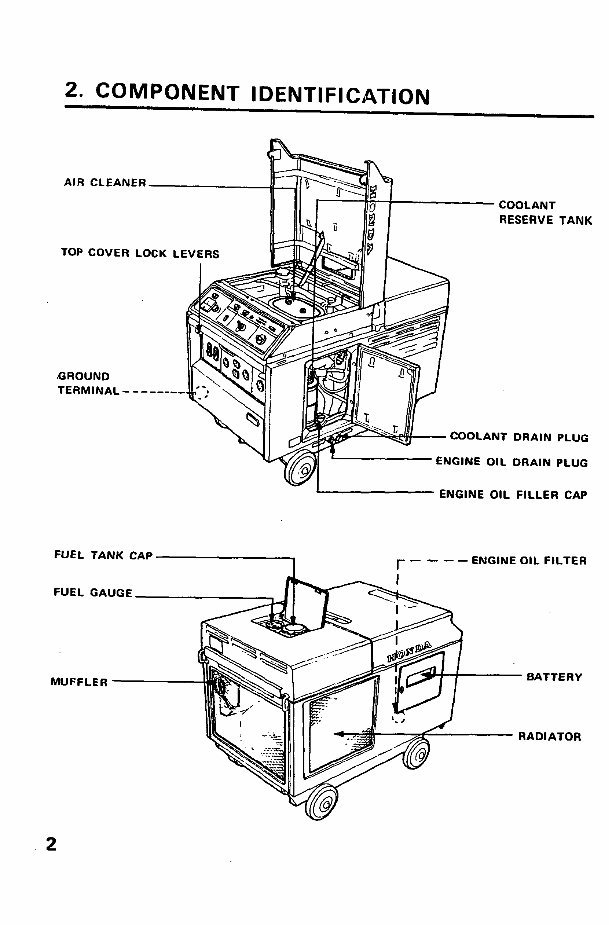
2. COMPONENT IDENTIFICATION
AIR CLEANER
TOP COVER LOCK L
.GROUND
TERMlNAL--------
ENGINE OIL FILLER CAP
r
--
- -ENGINE OIL FILTER
FUEL GAUGE
MUFFLER
2
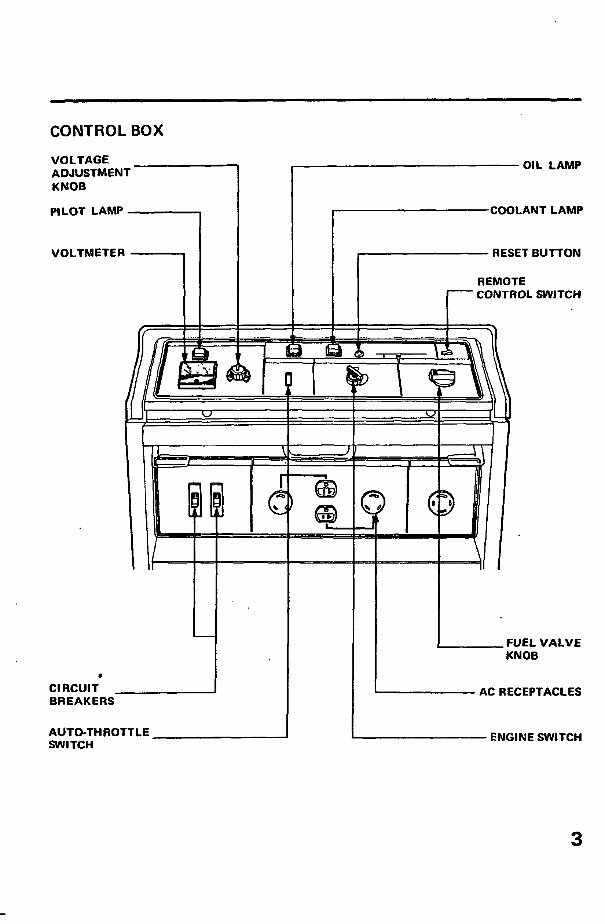
CONTROL BOX
VOLTAGE
ADJUSTMENT
KNOB
PILOT LAMP
VOLTMETER
Cl RCUIT
BREAKERS
AUTO-THROTTLE
SWITCH
RESET BUTTON
REMOTE
r
CONTROL SWITCH
ENGINE
1 FUEL VALVE
KNOB
AC RECEPTACLES
SWITCH
3
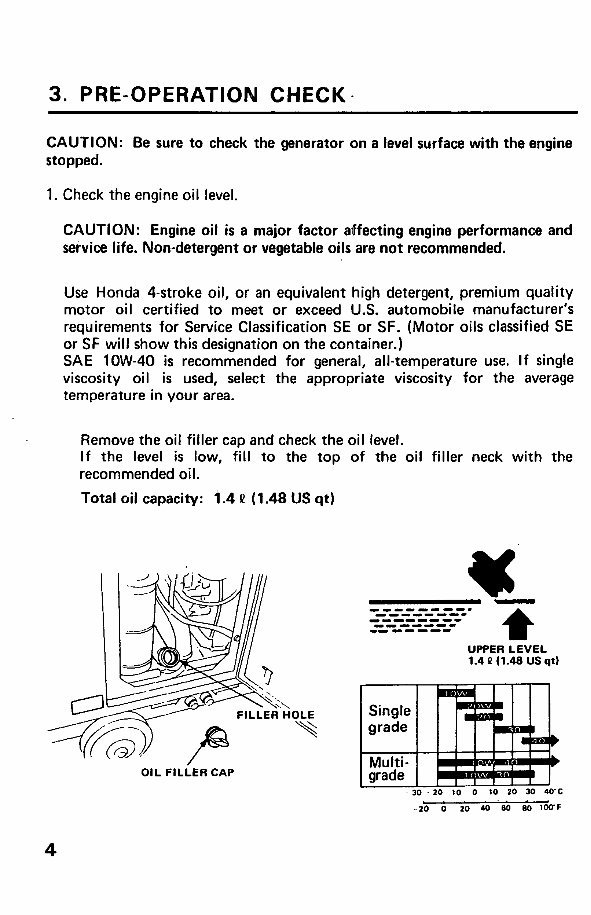
3. PRE-OPERATION CHECK-
CAUTION: Be sure to check the generator on a level surface with the engine
stopped.
1. Check the engine oil level.
CAUTION: Engine oil is a major factor affecting engine performance and
service life. Non-detergent or vegetable oils are not recommended.
Use Honda 4-stroke oil, or an equivalent high detergent, premium quality
motor oil certified to meet or exceed U.S. automobile manufacturer’s
requirements for Service Classification SE or SF. (Motor oils classified SE
or SF will show this designation on the container.)
SAE low-40 is recommended for general, all-temperature use. If single
viscosity oil is used, select the appropriate viscosity for the average
temperature in your area.
Remove the oil filler cap and check the oil level.
If the level is low, fill to the top of the oil filler neck with the
recommended oil.
Total oil capacity: i .4 P (1.48 US qt)
OIL FILLER CAP
4
u
-w-w----.
-w-w----
-------w
------w
*-w---w
+
UPPER LEVEL
1.4 P (1.48 us qt)
.-20 0 20 40 .00 80 IW’F
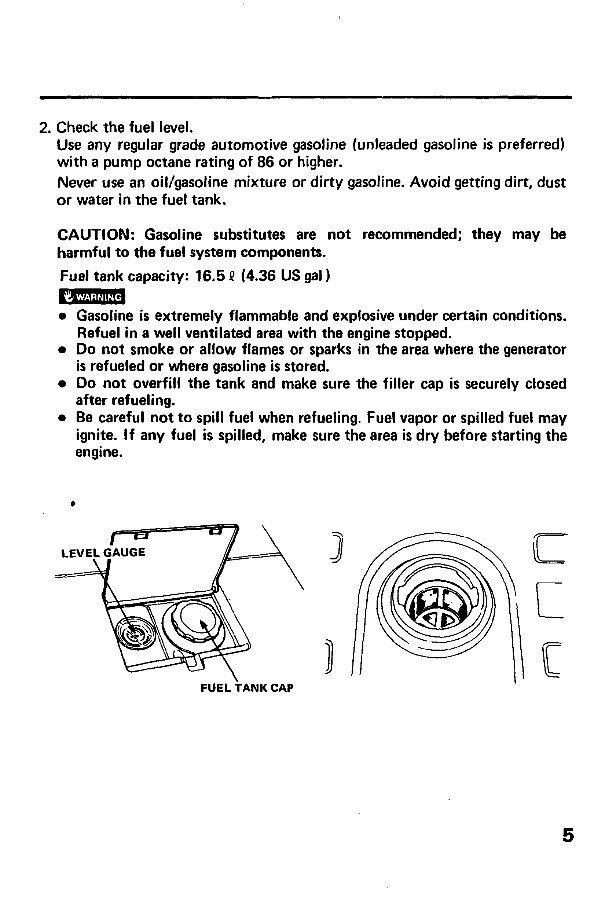
2. Check the fuel level.
Use any regular grade automotive gasoline (unleaded gasoline is preferred)
with a pump octane rating of 86 or higher.
Never use an oil/gasoline mixture or dirty gasoline. Avoid getting dirt, dust
or water in the fuel tank.
CAUTION: Gasoline substitutes are not recommended; they may be
harmful to the fuel system components.
Fuel tank capacity: 16.5 P (4.36 US gal 1
mm!!
.
Gasoline is extremely flammable and explosive under certain conditions.
Refuel in a well ventilated area with the engine stopped.
Do not smoke or allow flames or sparks in the area where the generator
is refueled or where gasoline is stored.
Do not overfill the tank and make sure the filler cap is securely closed
after refueling.
Be careful not to spill fuel when refueling. Fuel vapor or spilled fuel may
ignite. If any fuel is spilled, make sure the area is dry before starting the
engine.
FUEL HANK CAP
5
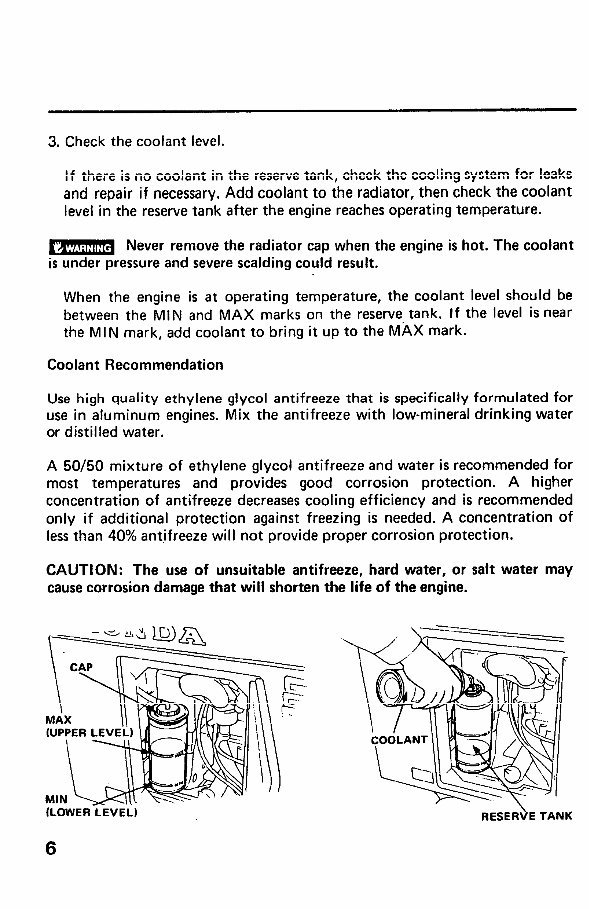
3. Check the coolant level.
If there is no coolant in the reserve tank, check the cooling system for leaks
and repair if necessary. Add coolant to the radiator, then check the coolant
level in the reserve tank after the engine reaches operating temperature.
M Never remove the radiator cap when the engine is hot. The coolant
is under pressure and severe scalding could result.
When the engine is at operating temperature, the coolant level should be
between the MIN and MAX marks on the reserve tank. If the level is near
the MIN mark, add coolant to bring it up to the MAX mark.
Coolant Recommendation
Use high quality ethylene glycol antifreeze that is specifically formulated for
use in aluminum engines. Mix the antifreeze with low-mineral drinking water
or distilled water.
A 50/50 mixture of ethylene glycol antifreeze and water is recommended for
most temperatures and provides good corrosion protection. A higher
concentration of antifreeze decreases cooling efficiency and is recommended
only if additional protection against freezing is needed. A concentration of
less than 40% antifreeze will not provide proper corrosion protection.
CAUTION: The use of unsuitable antifreeze, hard water, or salt water may
cause corrosion damage that will shorten the life of the engine.
lLOWER LEVEL)
RESERVE TANK
6
You're Reading a Preview
What's Included?
 Lifetime Access
Fast Download Speeds
Online & Offline Access
Access PDF Contents & Bookmarks
Full Search Facility
Print one or all pages of your manual
$30.99
$40.99
Honda Generator EX5500 Maintenance Manual
Viewed 20 Times Today

What's Included?
Lifetime Access
Fast Download Speeds
Online & Offline Access
Access PDF Contents & Bookmarks
Full Search Facility
Print one or all pages of your manual
$30.99
$40.99

Secure transaction
What's Included?
Lifetime Access
Fast Download Speeds
Online & Offline Access
Access PDF Contents & Bookmarks
Full Search Facility
Print one or all pages of your manual
The Honda Generator EX5500 Owners Maintenance Manual is an essential resource for anyone looking to maintain or repair their Honda Generator EX5500. This manual contains detailed information on the generator's components, specifications, and maintenance procedures. Whether you are a professional mechanic or a DIY enthusiast, this manual provides valuable insights into the proper care and upkeep of the Honda Generator EX5500.


